

Benjamin Banneker: Astronomer and Almanac Author
Quick Reference: Who Was Benjamin Banneker?
- Born: November 9, 1731, in Maryland, a free African American farmer, mathematician, and astronomer.
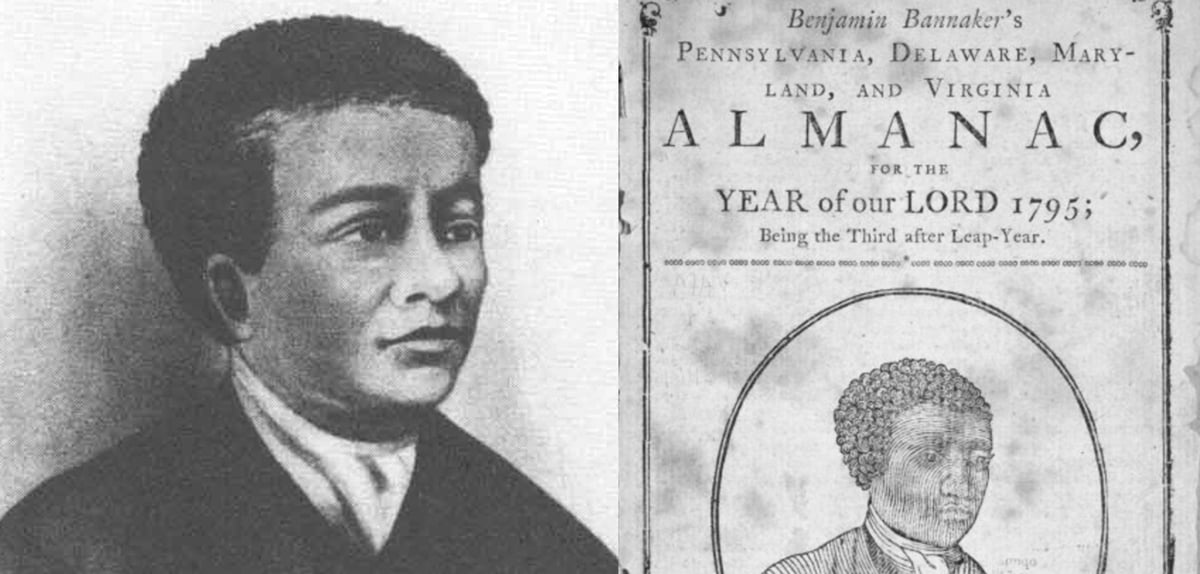
- Almanac author: wrote the Pennsylvania, Delaware, Maryland and Virginia Almanack and Ephemeris for six years, starting in 1792, across 28 editions.
- Famous feats: carved a working wood clock in 1752, forecast a solar eclipse on April 14, 1789, and helped survey the new Federal City in 1791.
- Letters to Jefferson: sent Thomas Jefferson a letter of rebuke and an abolitionist message bound with one of his almanacs.
- Died: October 9, 1806, at the age of 74.
This early American free black man published an almanac, predicted a solar eclipse, and fought with Thomas Jefferson over the abolition of slavery.
Long before the Farmers’ Almanac you read today, an 18th century almanac maker named Benjamin Banneker was charting the Sun, Moon, and stars by hand. Legend enshrouds the life and history of this free African American farmer, mathematician, and astronomer, who, near the end of his life in the 1790s, produced a series of acclaimed almanacs. We have been planning the year for readers since 1818, and Banneker was doing the same work, with the same patient sky-watching, a generation before us.
The fact that Banneker authored the Pennsylvania, Delaware, Maryland and Virginia Almanack and Ephemeris for six years, starting in 1792, was an amazing feat considering much of the United States was still in the grips of slavery and the ranks of black statesman were few.
Sadly, the bulk of Banneker’s writings and notable scientific research was destroyed when his cabin, located within a mile of the Patapsco River near Ellicott’s Mills, burned down on the day of his funeral. But 200 years later, researchers continue to piece together tales of a man who broke through the imposing color barrier of Early America. You can read a fuller account of his life from the National Park Service’s notebook on Benjamin Banneker.
Oral history indicates that Banneker’s story begins with an English woman named Molly Welsh who came to America as an indentured servant before gaining her freedom. Once freed, she acquired land and purchased two slaves in order to start a farm. She freed them over time, and eventually married one of the slaves named Bannaka. Together they had several children. One of them, Mary, married a freed slave who took the Christian name Robert.
Benjamin Banneker was born to Mary and Robert on Nov. 9, 1731. When Benjamin was six years old, his parents purchased a 100-acre farm with 7,000 lbs. of tobacco. They put his name on the deed to ensure that his ownership would never been contested.
Stellar Student
Learning came naturally to Banneker, and by age 15, he gained a rudimentary education. In 1752, his brilliant mind attracted attention when he borrowed a watch from a neighbor, took it apart, and quickly made carved-wood copies of the parts in order to assemble a working clock. This clock was said to keep accurate time for 40 years, until it was destroyed when his home burned.
He learned to play the flute and violin, started a watch and clock repair business, and studied the stars hour upon hour. Among his astronomical accomplishments was successfully forecasting a solar eclipse on April 14, 1789, in contradiction to the predictions of top astronomers and mathematicians of the era. That kind of careful, math-based prediction is the same tradition the Farmers’ Almanac has leaned on for more than 200 years.

Against All Odds
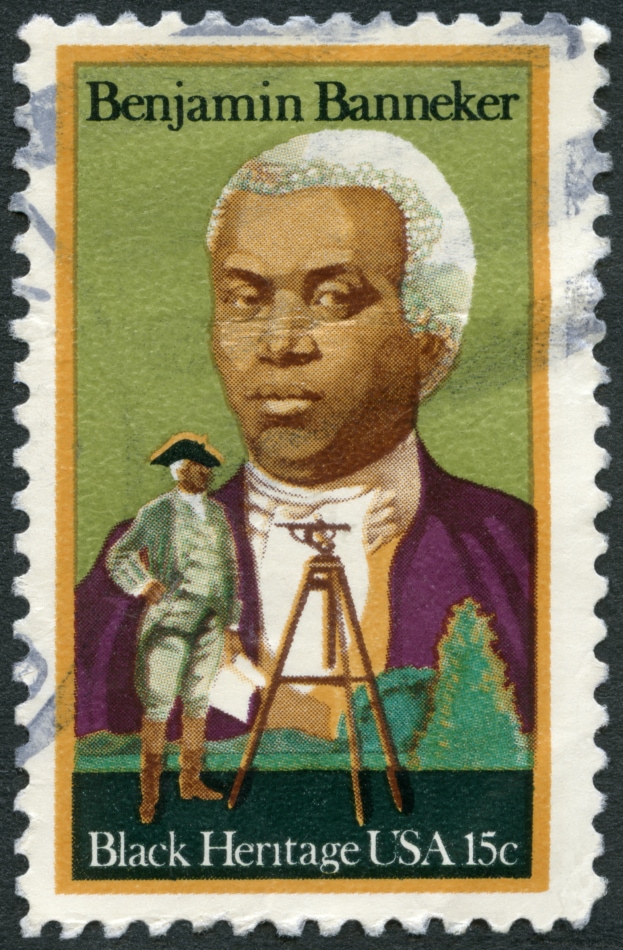
In 1791, Banneker was hired by the surveyor contracted by President George Washington to help survey the boundary of the new Federal City. About that time, US Secretary of State and future president Thomas Jefferson was quoted as saying blacks had inferior mathematical abilities. The Georgetown Weekly Ledger, however, took note of Banneker, noting that he was “an Ethiopian whose abilities as surveyor and astronomer already prove that Mr. (Thomas) Jefferson concluding that that race of men were void of mental endowment was without foundation.”
One of Banneker’s almanacs was published with a letter of rebuke to Jefferson and an abolitionist message. In part, he accused the slave-holding Jefferson of “detaining by fraud and violence so numerous a part of my brethren under groaning captivity and cruel oppression, that you should at the same time be found guilty of that most criminal act, which you professedly detested in others, with respect to yourselves.”
Jefferson responded: “Nobody wishes more than I do to see such proofs as you exhibit, that nature has given to our black brethren, talents equal to those of the other colors of men, and that the appearance of a want of them is owing merely to the degraded condition of their experience both in Africa and America.” The full exchange between the two men, sent in August 1791, is preserved by the National Park Service in its record of the letters of Banneker and Jefferson.
Almanac Author
Banneker’s almanacs were published for the readerships of several cities and in 28 editions. They contained content on tide tables for the Chesapeake Bay region, weather forecasts, motions of the Sun, Moon, and planets, days of festivals, a list of Supreme Court sessions, essays on various topics, and prose. If that table of contents sounds familiar, it should: the modern Farmers’ Almanac still tracks the phases of the Moon and the Best Days for everyday tasks, the same patient sky-watching Banneker practiced.
Banneker published almanacs for six years and many of his quotes have had a lasting significance. Here are a few of those he stated in print:
“The color of the skin is in no way connected with the strength of the mind or intellectual powers.”
“Were there no uniforms, there would probably be no armies.”
“Evil communication corrupts good manners. I hope to live to hear that good communication corrects bad manners.”

In his old age, Banneker remained active writing and researching. He researched bees and conducted a mathematical study on the life cycle of the 17-year locust, all while continuing to chart the stars. He died on October 9, 1806, at the age of 74.
Banneker and the Almanac Tradition
An almanac is, at heart, a yearly planner built from the sky. Banneker filled his pages with tide tables for the Chesapeake Bay, the rising and setting of the Sun and Moon, the festival days, and the weather a reader could expect. He calculated the ephemeris himself, the table that tracks where the Sun, Moon, and planets sit on each day of the year. It is slow, exacting math, and he did it with borrowed instruments and a homemade desk.
We recognize the work. The Farmers’ Almanac was first published in 1818, and the same questions Banneker answered for his neighbors are the ones we answer for readers now: when is the best day to plant, to fish, to set out before the weather turns. His almanacs were sold across several cities and ran for six years, proof that careful, math-based forecasting earns a reader’s trust no matter who holds the pencil.
Efforts continue today to bring more attention to Banneker’s life and work. To learn more, you can visit the Benjamin Banneker Historical Park & Museum, located on the original Banneker farm property in Baltimore County, Maryland.

Benjamin Banneker: Frequently Asked Questions
Who was Benjamin Banneker?
Benjamin Banneker was a free African American farmer, mathematician, and astronomer, born November 9, 1731, in Maryland. He is best remembered for building a working wood clock in 1752, forecasting a solar eclipse, helping survey the new Federal City, and publishing a series of acclaimed almanacs in the 1790s.
What almanac did Benjamin Banneker write?
He authored the Pennsylvania, Delaware, Maryland and Virginia Almanack and Ephemeris, starting in 1792 and continuing for six years across 28 editions. It carried tide tables for the Chesapeake Bay region, weather forecasts, the motions of the Sun, Moon, and planets, festival days, a list of Supreme Court sessions, essays, and prose.
How did Benjamin Banneker build a clock?
In 1752 he borrowed a watch from a neighbor, took it apart, and carved wood copies of the parts to assemble a working clock. The clock was said to keep accurate time for 40 years, until it was destroyed when his home burned.
What did Benjamin Banneker write to Thomas Jefferson?
Banneker sent Jefferson, then US Secretary of State, a letter of rebuke and an abolitionist message bound with one of his almanacs. He accused the slave-holding Jefferson of “detaining by fraud and violence so numerous a part of my brethren under groaning captivity and cruel oppression.” Jefferson replied that he wished to see proofs “that nature has given to our black brethren, talents equal to those of the other colors of men.”
Did Benjamin Banneker help survey Washington, D.C.?
Yes. In 1791 he was hired by the surveyor contracted by President George Washington to help survey the boundary of the new Federal City, the land that became Washington, D.C.
When did Benjamin Banneker die?
He died on October 9, 1806, at the age of 74. His cabin near Ellicott’s Mills burned down on the day of his funeral, destroying much of his writing and research, including the clock he had carved decades earlier.


Jim Kneiszel
Jim Kneiszel is a freelance writer based in De Pere, Wisconsin. He edits a number of trade publications and runs The Word House with his wife, Judy. His article, Infuriating and Frightening Invasive Species appears in the 2021 Farmers' Almanac.
- Jim Kneiszel

- Jim Kneiszel
- Jim Kneiszel
- Jim Kneiszel





Wonderful man for the world to know!
Yes! We think so too.